Saturday, 30 August 2014

Francesca Woodman Again ....................

Double Portrait, Rome, Italy, 1977-78
Double PortraitRome, Italy, 1977-78 © The Estate of Francesca Woodman
Untitled MacDowell Colony, Peterborough, New Hampshire, 1980
UntitledMacDowell Colony, Peterborough, New Hampshire, 1980 Photograph: © The Estate of Francesca Woodman
Francesca Woodman, Untitled, New York, 1979-1980
UntitledNew York, 1979-1980 Photograph: © The Estate of Francesca Woodman
Francesca and George Woodman, circa 1980
Francesca and George Woodman, circa 1980 Photograph: © The Estate of Francesca Woodman
Untitled Providence, Rhode Island, 1976
UntitledProvidence, Rhode Island, 1976 Photograph: © The Estate of Francesca Woodman
Untitled Providence, Rhode Island, 1975-78
UntitledProvidence, Rhode Island, 1975-78 Photograph: © The Estate of Francesca Woodman
Space2 Providence, Rhode Island, 1975- 1976
Space2
Providence, Rhode Island, 1975- 1976 Photograph: © The Estate of Francesca Woodman
Untitled New York, 1979-80
UntitledNew York, 1979-80 Photograph: © The Estate of Francesca Woodman
Francesca Woodman, c. 1979 Photographed by George Woodman
Francesca Woodman, c. 1979 Photographed by George Woodman Photograph: © The Estate of Francesca Woodman

Sunday, 25 May 2014

Eleanor Marx is talking an extract by E.P. Thompson at marxist org archive

When I first wrote my study of William Morris over twenty years ago I inclined to Kapp’s judgement, and gave both Eleanor and Engels the benefit of the doubt. But since that time the Engels-Lafargue correspondence has become available, and I have consequently sharpened my own judgement in revision. Engels’s lofty dismissal, in l887, of the existing socialist movement in Britain as ‘a number of small cliques held together by personal motives’, comes uneasily from a man who was at the centre of the smallest and most personally-motivated clique of all. The Avelings, having hurried on the split in the SDF, failed then to give a full commitment to the Socialist League, formed a faction within it, and forced on a further split which destroyed their own creation. Engels, who indignantly rebutted each and every attack on Aveling as the malicious slander of political enemies, was both the captive of Aveling and his political mentor. His personal motives (loyalty to ‘Tussy’) were admirable. But in the result he contributed in a small way to the confusions of the early movement and to the repute into which ‘British Marxism’ fell.
Aveling (it seems) surrounded himself with bouncing cheques and left other people to settle his bills and to comfort his discarded mistresses. The notion that these private vices can be segregated from his public and political virtue will not hold ice. His was the behaviour of an élitist, who made a tolerable and entertaining living for himself in the top storey of a poor movement. But what of that other notion, so prevalent now that it may be called a stereotype, that Eleanor all along was the noble and innocent victim of his abuse? Her suicide projected this interpretation backwards, across the previous fifteen years; by killing herself as she did, in a final protest against him, she rejected the name she had long chosen – Eleanor Marx Aveling – and re-entered a purified history as Eleanor Marx.
But I do not think this notion will do either. Eleanor also first entered the movement as a special person, an élitist, the daughter of ‘Mohr’. She could not possibly have been other. She was spoiled by Engels and invited instantly into the control-room of the Tardis. His sardonic contempt of those bungling English socialists rubbed off on her. She was an enthusiastic Bohemian who shared Aveling’s theatrical ambitions and who enjoyed his round of one-act plays, sentimental comedies and soirées. It is difficult not to see ‘the Avelings’ in the 1880s except as a double act. If Dr Aveling enraged the American socialists by charging them 25 dollars for ‘corsage bouquets’, Mrs Aveling was the one who wore them. I think it probable that in these early years she found Edward’s flouting of bourgeois financial proprieties to be daring and amusing. She learned, to her grievous cost, otherwise. But in those days they certainly appeared to outsiders as a marital package. When Bernstein spoke in the advanced Fabian household of the Blands of the Avelings, ‘there was suddenly a suspiciously unanimous chorus of praise of them. “Oh, the Avelings are very clever people.” “Oh, everybody must admit that they have been of great service to the movement,” and so forth.’ It is always remembered that Shaw’s Dubedat (‘as natural as a cat, he moves among men as most men move among things’) is derived from Aveling; it is less often recalled that (in Bernstein’s view) ‘the deliberate blindness and deafness of Mrs Dubedat in respect of all that was said to the detriment of her husband’ is equally derived from Eleanor:
Of course when he says he doesn’t believe in morality, ordinary pious people think he must be wicked. You can understand, can’t you, how all this starts a great deal of gossip about him, and gets repeated until even good friends get set against him?
The important word is ‘deliberate’.
In her socialist propaganda work in the 1880s Eleanor was an enthusiast. I find in an old notebook a letter of hers proposing in October 1885 that a Christmas Tree be organised for the children of the Socialist League:
We cannot too soon make children understand that Socialism means happiness. Perhaps some friends (I tremble a little at the thought of Bax) will object to a Christmas tree. If they or he shd I will only remind them of the origin of the Christian festival – of the beautiful old Pagan feast that celebrated the birth of light. Let us, like the Christians, adopt this old story to our purpose. Is not Socialism the real ‘new birth’, & with its light will not the old darkness of the earth disappear?
This is the Eleanor whom Marxists have always cherished, the passionate daughter of Marx who disproves in all her life the libelling of the family as cold-blooded materialists. Yet we have also to remember that the enthusiastic comrade, who combines a ready resource of emotion with an absolute conviction of her own political integrity, can sometimes be an unsettling, even disruptive, fellow worker. Yvonne Kapp gives us a curious insight into the aftermath of Bloody Sunday (1887). The demonstrators were prevented from entering Trafalgar Square by over 4,000 police and 600 guardsmen. The Radical, Irish and Socialist crowds were ingloriously routed, 200 of them to hospital. The next question for the movement was what to do next week – whether to rush the Square once more or whether to demonstrate in Hyde Park. Eleanor, writing to sister Laura, had not a moment of doubt:
We shall urge going to the Square, but I fear many will funk ... If we can induce them to go next Sunday, it will mean very warm work. Last Sunday the troops had ammunition ready and stood with fixed bayonets. Next Sunday I think it very possible they will actually fire. That would be very useful to the whole movement here. It would complete the work some of us have been doing this long while past, of winning over the better Radical element to Socialism.
A delegate meeting of Radical clubs was called to take the decision, and a witty Radical reporter noted:
In front of the platform sat Lady Macbeth Aveling and the redoubtable Edward, D.Sc. They were of course in favour of a spirited dash at Trafalgar Square; and very fine it was to see the lofty scorn of Lady Macbeth when any speaker on the pacific side rose to address the meeting. When the resolution proposing the Hyde Park meeting was read Lady Macbeth turned to Edward. D.Sc , and hissed ‘C-o-w-a-r-d-s!’ between her teeth.
Among those whom Eleanor implied to Laura were ‘funks’ was William Morris, since he was less than convinced that the unleashing of the military upon an unarmed crowd would be ‘very useful to the whole movement’. And Yvonne Kapp notes approvingly: ‘While Eleanor learnt from Bloody Sunday that the working class had not yet enough experience of struggle, Morris drew the conclusion that it had not yet enough education or organisation to engage in struggle’. This is untrue, as Kapp must know, since she has just quoted Morris’s own judgement on the matter: he proposed that the demonstrators should immediately learn to struggle more effectively, by organisation, crowd discipline and drill, and ‘a due system of scouts, outposts and supports ...’
Eleanor maintained this faith in the educative value of a severe defeat, which would make the real class struggle apparent and bring recalcitrant Britain into line with the Continent. In the last year of her life, while assisting the engineers in their long lock-out, she admitted in a letter to Natalie Liebknecht that ‘we are hopelessly beaten’. ‘It is true – ... entre nous – the beating may, in the long run be as useful to our cause, more useful perhaps, than a half-hearted “victory” ...’ This did not prove to be true, and, in general, too many of Eleanor’s political judgements are spoiled by this kind of warm-hearted and wilful political emoting.

Friday, 28 February 2014

Hannah Wilke, S.O.S Starification Object Series, 1974


Wilke is possibly best known for the photographs included in her self-described “performalist” self-portrait S.O.S Starification Object Series. In these seminal images, Wilke covered her body with the small vulva forms she shaped from used chewing gum. The gums, mimicking the larger form of the folded sculptures, represent scars or growths and contrast with Wilke’s flirtatious advertisement style glamour poses. 
Hannah Wilke was born in New York in 1940. She lived and worked in New York until her death from lymphoma in 1993 at the age of 53. Her work is represented in the collections of The Solomon R.Guggenheim Museum, New York; The Museum of Modern Art, New York; The Whitney Museum of American Art, New York; The Museum of Contemporary Art, Los Angeles and The Walker Art Center Minneapolis. A retrospective of Wilke’s work was mounted by Artrium-Centro Museo Vasco de Arte Contemporaneo, Vitoria, Spain, in October 2006 and her work was recently featured in the critically acclaimed exhibition WACK! Art and the Feminist Revolution at The Museum of Contemporary Art, Los Angeles.

Thursday, 30 January 2014

Adrian Piper ( another find)

Adrian Piper Food for the Spirit #4, 1971. Silver gelatin print, 14.5 x 15 in, ed. of 3 (+1 AP).

Monday, 7 October 2013

the sheltering sky

“How fragile we are under the sheltering sky. Behind the sheltering sky is a vast dark universe, and we're just so small.” 
― Paul BowlesThe Sheltering Sky


Are you lost ?

yes I am lost 

seeing the film again and after 20 years

what is left of me ?

after 30 years when I dreamed to be another

the way we punish ourselves

for wanting to escape

the white women

versus the latin women

the latin women versus the african one

but we where all just one alone

I just know that I felt ( was this a once more burgueoise dream?)

That it was possible

it was possible

I cry now

from a desk on english lands

as an alien

loveless

and I remember who I was

the mint tea

the market lights

and the kisses of the men

that crossed my path

as they where travellers standing

kissing lips after lips of men and women alike

their gazelle eyes

their musk oiled skin

travelling and loving

escaping for ever

the drums under the stars

and my split been called Nedjma


Hotel at Rabat 1986 picture Jorge Esteva 

Saturday, 21 September 2013

on this alienation
what can we say ?
it is
liquid
it is lonely
with a lightened screen
that brings people
to me
unknown
unknown
they come
they go
they masturbate
they fuck
mean wile
from here
hidden ?
alone
I can feel its all
dispersing
there are particles of sound
this voices that are
only
text
only text
only
every day
the fiction
but is so real
its so real
it makes me
want to swim
for ever
for ever
its pitch black
we are all this tiny stars
we are alone
we are alone
its online
liquid sky

Saturday, 14 September 2013

the spleen repeats 1980 a poem from 2013

of the limbo  like life of a girl /women on a burgueoise  society from a fascist country ( the only one remaining ) where all is a grid :

in Spanish :

El miedo
siempre presente

y el aburrimiento
muy muy
frecuente
me aburro !!

menciono muchas veces
a través de 1980

soy una mierda !

anuncio

y a el
ya no lo veré más


in English

That fear
present always

and the spleen
very very
frequent
I am bored!

I mention many times
trough out 1980

I am shit !

I announce

and him
I will never see him again


Sunday, 8 September 2013

Annette Messager ( found images and self etnographic exercise )

I have just found this works , I heard about Annette but never seen what she did in those times......
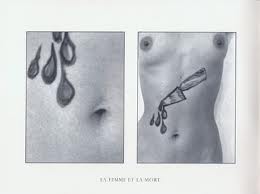
again , I find a woman questioning her self , her identity , another Nadja . And the context , the map and the territoire for doing so, its her body again another female asking her self asking her body , using her self using her  own body . But it is not precisely this being used to use our body , to test constantly the vessel of our soul , the feminine envelope that has been made up for us ? either covered in pink , rose tissues and fabrics , or pierced for small earrings ........ a body that seems to envy to not have a prominent organ wile it actually has a deep warm hole /cut . I can say that we experiment with our selves on the small room closed inside , we imagine and test . But naked is also important , because it is a claim of how we feel , maybe devoid of real nakedness ? maybe too cover up by signifiers of the feminine ? so here we are , using the camera always the eye of a machine that capture "that us" that we don't know we are .  


Saturday, 7 September 2013

She ( a new women on my research , that worked on a similar line , and that like me was not easy to define or classify )

ART REVIEW

She Creates Herself in Multitudes

Eleanor Antin’s Selves at Columbia University


Private collection

"The Two Eleanors" (1973), a work in which Eleanor Antin plays with identity.


    Courtesy the artist and Ronald Feldman Fine Arts
    Eleanor Antin as the King of Solana Beach in 1972.


    A difficult-to-categorize figure whose career veered from art into theater and back again, she is best known for her 1972 performance/photography piece “Carving: A Traditional Sculpture,” a visual diary of her naked body as it was diminished by a 37-day diet. That somber, almost classical work is such a staple of early feminist art that it’s strange to discover, in this exhibition, that it was just one of her many theatrical and provocative self-transformations.
    For three weeks in 1980, for instance, she went out in public dressed as a fictional historical figure of her invention: Eleanora Antinova, a black ballerina in Diaghilev’s Ballets Russes. (Ms. Antin, who is white, darkened her skin with makeup; she could not do much about her short-limbed, un-dancerlike build.) She recorded her experiences in a “memoir,” “Being Antinova,” adding to an already substantial archive of photographs and drawings made in character.
    A few years earlier she pasted a beard onto her face, donned a cape and wide-brimmed hat and made the rounds of San Diego as the King of Solana Beach, a figure with a distinct resemblance to the 17th-century monarch in portraits by Van Dyck. Trailed by bemused locals, the King shops for groceries, goes to the post office and perches regally on an old sofa that’s been left at the curb.
    With an assortment of photographs, videos and set pieces, “Multiple Occupancy” examines Ms. Antin’s major selves — some of them female (ballerinas, nurses) and some male (the King and an exiled Russian film director). These characters may not seem to have much in common with one another, or for that matter with Ms. Antin, but they are all, in their way, frustrated outsiders. The King struggles to govern a Vietnam-era populace that’s deeply suspicious of authority; Antinova aspires to play Giselle, but keeps getting cast as Pocahontas.
    “I deliberately gave Antinova a traditional art form because I was already at odds with one, traditional Conceptual Art,” Ms. Antin tells the show’s curator, Emily Liebert, in an illuminating catalog interview. (Ms. Liebert, a Ph.D. candidate in the art history department at Columbia, is working on a dissertation about the selves.) Conceptual Art, as Ms. Antin saw it in the 1970s, was a boys’ club; it was also intellectually rigid, with little room for narrative, biography or fantasy.
    The first stirrings of the selves have the narcissistic sensibility of other early video and performance art (by, say, Bruce Nauman and Vito Acconci). In two videos that open the exhibition, Ms. Antin can be seen sitting before a mirror applying makeup (in “Representational Painting”) and a beard (in “The King”). But by the time the first ballerina appears, in serial photographs and a video from 1973, it’s clear that Ms. Antin is bringing feminism and some element of personal experience into the mix.
    This stumblebum of a dancer — a precursor to Antinova — struggles to hold various ballet positions, shouting at a photographer to take the picture before she loses her footing. Like an even more cruelly realistic version of Degas’s dancers at the barre, she reminds us that not every little girl in a tutu can become a real ballerina (and makes us wonder why so many still want to).
    Not all of the selves are equally compelling. Sometimes they become a kind of shtick: Little Nurse Eleanor, for instance, suffers a repetitive series of indignities that highlight stereotypes of the “scapegoat, nurturer, servant, sex object and fantasy”; Ms. Antin represents this hapless figure with a paper doll, turning her into a sort of female Mr. Bill. (Fortunately, the nurse “self” evolves into a more complex character, Nurse Eleanor Nightingale, whose Crimean War back story allows Ms. Antin to comment, elliptically, on the carnage of Vietnam.)
    But in at least one case they come across as sincere homage, like the film Ms. Antin made as Yevgeny Antinov, a film director exiled from Russia for supposed Trotskyite sympathies. Released as a feature-length independent movie, “The Man Without a World” chronicles life in a Polish shtetl and is closely modeled on silent films of the 1920s. Ms. Antin has called it a tribute to her mother, who had been an actress in Poland’s Yiddish theater.
    Even the weaker selves, however, exist in a fascinating and mysterious realm between mediums. They bridge photography and performance, film and literature, paper dolls and live humans. Often one type of representation will sabotage another; the ballerina is convincing enough in stills, but on video she falls apart.
    The way Ms. Antin develops her selves, over years and sometimes decades, is just as interesting. She will add chapters or “discover” lost works — for instance, “archival” footage of Antinova’s late, desperate years on the vaudeville stage. She will also revisit performances, as she did this year when she reinterpreted her 1979 play “Before the Revolution,” casting an African-American actress in the role of Antinova.
    “Multiple Occupancy” should endear Ms. Antin to an art world fixated on aliases, alter egos and falsified archives. (See the Atlas Group, Otabenga Jones & Associates, Henry Codax and the painter who may or may not be Bob Dylan,) Her “selves” may have been invented in the 1970s, taking their identities from the distant past, but they are undisputably a part of the present.


    “Multiple Occupancy: Eleanor Antin’s ‘Selves’ ” runs through Dec. 7 at the Miriam and Ira D. Wallach Art Gallery at Columbia University, 1190 Amsterdam Avenue, near 119th Street; (212) 854-7288, columbia.edu/cu/wallach.

    Sunday, 25 August 2013

    Who am I ????

    Who am I ? asked Nadja ,
    Nadja , the spirit of guidance ..the Diotima of monsieur André Breton , the surreal ultimate real muse, Nadja is the predated Daemon of Guy Ernest Debord too , the Situacionist implementor .

    Nadja is Derive and Drift ..and its also the anima of Charles Baudelaire talking to André , that even if polarised on his maleness found an Eve for his walkings around Le Paris he has given to us on his novella with the same name and title : Nadja

    To be Nadja , is not to exist at all but also been a kind of female ......here is when Esther enters centre stage .

    To wander floating like and to not know who one is ..........Esther = Nadja

    Nadja = you

    you = Nadja


    Djin = Nadja

    decessed ghost of female Charles Baudelaire
    post-Socratic Diotima
    post- Platonic Wisdom

    Foucauldian truth

    This Female that is on permanent crisis .................
    Because of her Ethereal existence ... her just been an image a channelling force .......
    a male invention ....